Mumbai:
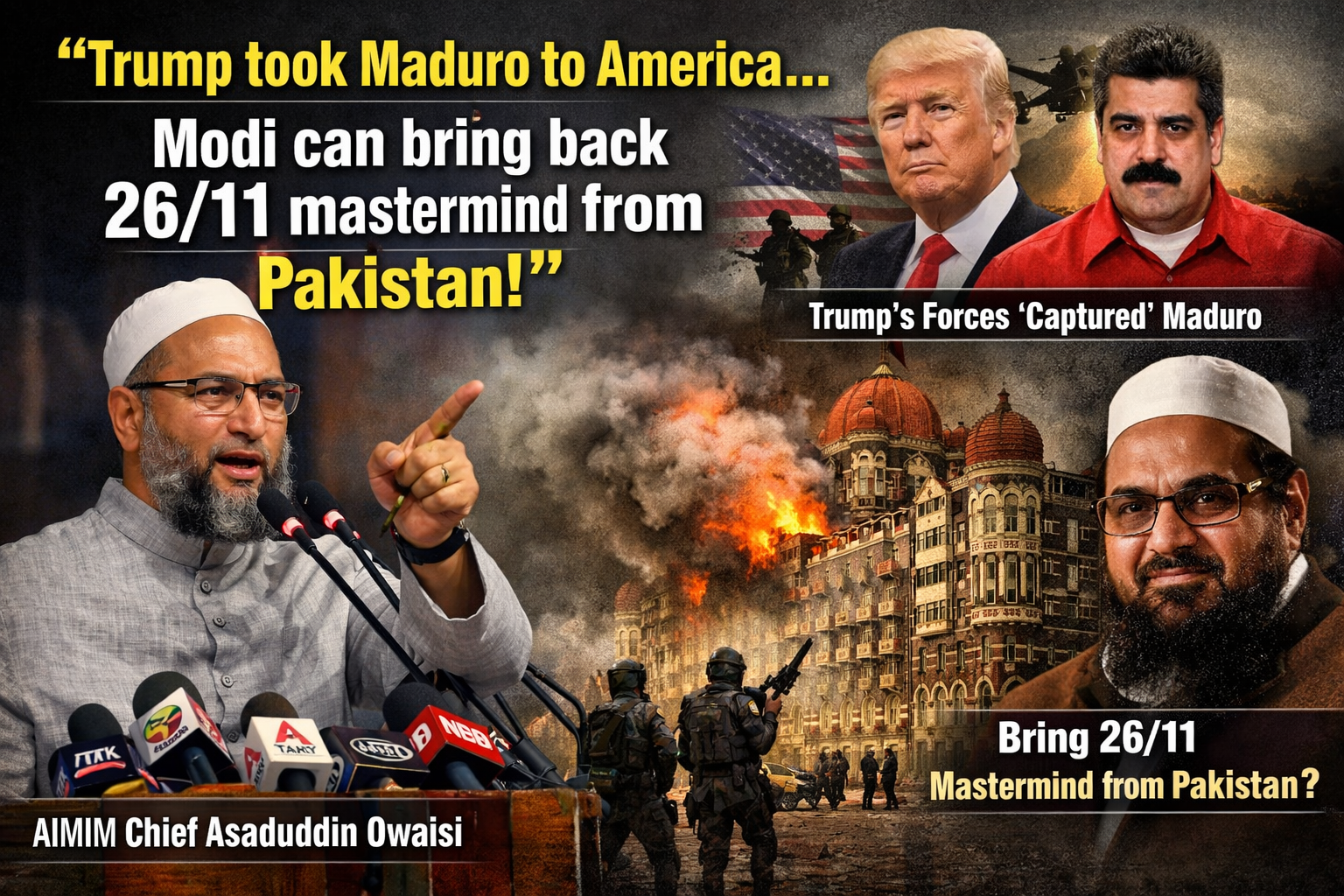
All India Majlis-e-Ittehadul Muslimeen (AIMIM) chief and Member of Parliament Asaduddin Owaisi has once again made a strong and controversial statement targeting the Central government over the long-pending issue of bringing the masterminds of the 26/11 Mumbai terror attacks to justice.
Speaking at a public gathering in Mumbai, Owaisi referred to recent international developments involving the United States and Venezuela and used them to question India’s diplomatic and strategic approach toward Pakistan.
“If the US Can Do It, Why Can’t India?” – Owaisi’s Question
Addressing the audience, Owaisi said:
“Today we heard that US President Donald Trump’s forces captured Venezuelan President Nicolas Maduro and took him from his country to America. If US President Donald Trump can abduct Venezuelan President Nicolas Maduro from his own country, then you (Prime Minister Modi) can also go to Pakistan and bring back the mastermind of the 26/11 terrorist attacks to India.”
Through this statement, Owaisi attempted to draw a comparison between America’s assertive global actions and India’s response to terrorism emanating from across the border.
Background: The 26/11 Mumbai Terror Attacks
The 26/11 attacks, which took place in November 2008, remain one of the deadliest terrorist attacks in India’s history.
- Over 160 people were killed
- Hundreds were injured
- Iconic locations such as Taj Hotel, CST Station, and Nariman House were targeted
Investigations revealed that the attacks were planned and executed by Pakistan-based terror outfit Lashkar-e-Taiba, with several alleged masterminds still believed to be in Pakistan.
Despite years of diplomatic pressure, dossiers, and international appeals, India has not yet been able to extradite the key conspirators.
Owaisi Targets Government’s Foreign Policy
Owaisi’s remarks were clearly aimed at questioning the foreign policy strength and political will of the Modi government. He implied that if global powers like the US can take decisive actions beyond borders to protect their national interests, India should also act firmly to ensure justice for victims of terrorism.
He further accused the Centre of making strong statements domestically while failing to deliver concrete outcomes on the international stage.
Political Reactions and Controversy
As expected, Owaisi’s statement sparked political debate:
- Supporters argued that he raised a legitimate concern about accountability and justice for terror victims.
- Critics accused him of making unrealistic comparisons and oversimplifying complex international relations and sovereignty issues.
- Some political leaders also questioned the factual basis of his remarks while emphasizing that diplomacy and international law govern such actions.
India–Pakistan Relations and the Terror Issue
India and Pakistan share a tense relationship, especially over terrorism and cross-border militancy. While India has repeatedly raised the issue at international forums like the United Nations, actual extradition of terror suspects remains a major challenge due to diplomatic, legal, and geopolitical constraints.
Asaduddin Owaisi’s statement reflects growing frustration among sections of the political spectrum and the public over the unresolved issue of justice for the 26/11 attacks. Whether one agrees with his comparison or not, his remarks have once again brought the focus back on the unfulfilled demand for accountability and the larger question of how nations deal with cross-border terrorism.
The debate highlights a critical dilemma: balancing international diplomacy with national security interests—a challenge that continues to confront India more than a decade after the tragic events of 26/11.